
The OSI Model is useful for learning networking.
However, real networks do not actually implement the OSI Model.
Modern networking is based on the TCP/IP Model.
Why Two Models Exist
OSI was designed as a theoretical framework.
TCP/IP evolved from real-world networking protocols that eventually became the Internet.
Today:
OSI
=
Learning Model
TCP/IP
=
Real Networking Model
When network engineers, administrators, attackers, and defenders discuss networking, they are usually thinking in terms of TCP/IP.
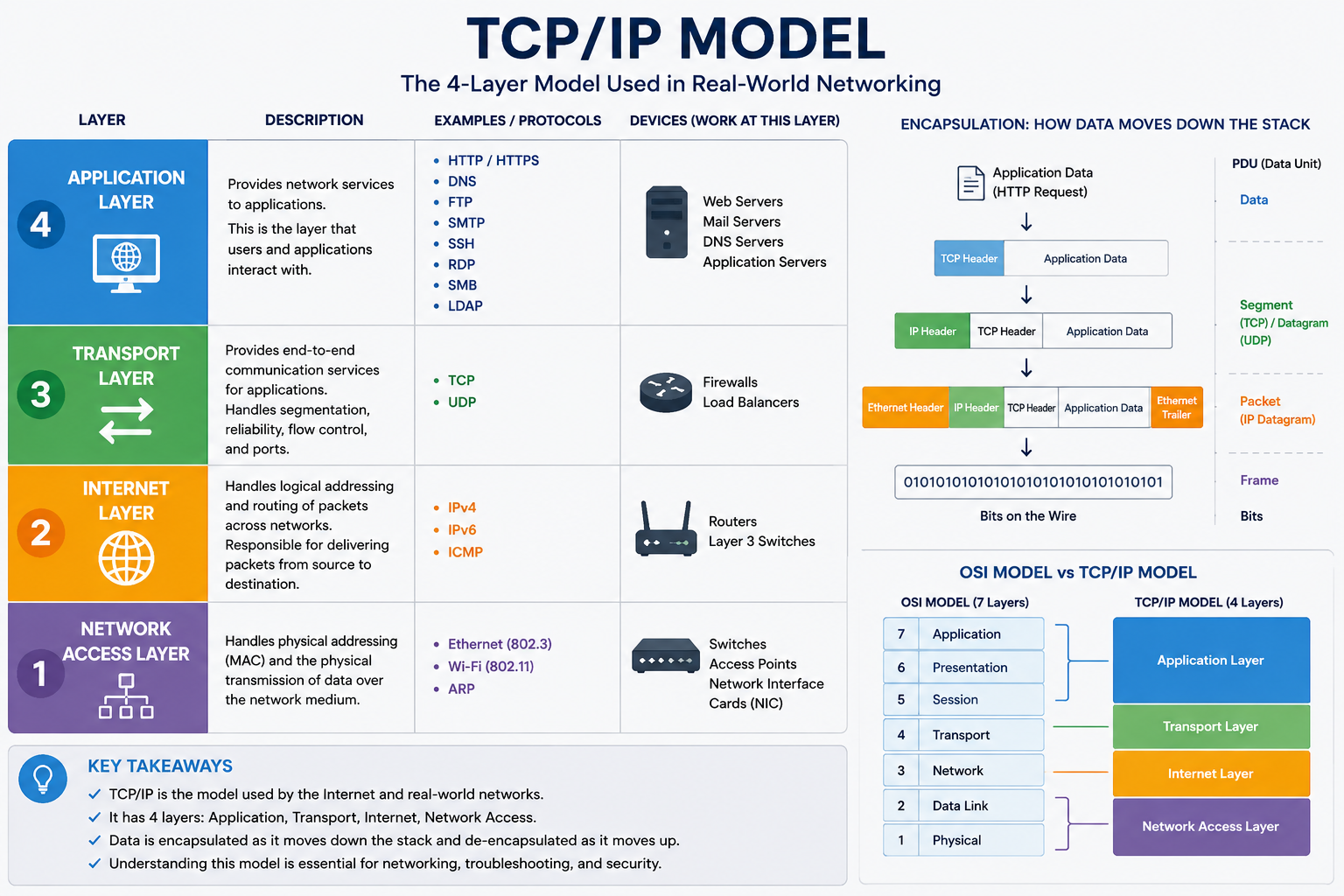
TCP/IP Layers
Unlike OSI's seven layers, TCP/IP uses four layers.
Application
Transport
Internet
Network Access
Visualized:
+-------------------+
| Application       |
+-------------------+
| Transport         |
+-------------------+
| Internet          |
+-------------------+
| Network Access    |
+-------------------+
OSI vs TCP/IP
OSI Layer 7 ┐
OSI Layer 6 ├── TCP/IP Application
OSI Layer 5 ┘

OSI Layer 4 ─── TCP/IP Transport

OSI Layer 3 ─── TCP/IP Internet

OSI Layer 2 ┐
OSI Layer 1 ┘── TCP/IP Network Access
Notice that TCP/IP combines several OSI layers together.
Application Layer
The Application Layer contains protocols used directly by applications.
Examples:
HTTP
HTTPS
DNS
FTP
SMTP
SSH
RDP
LDAP
SMB
Examples of applications:
Chrome
Firefox
curl
Outlook
mstsc
This is where most pentesters spend their time.
Transport Layer
The Transport Layer provides communication between applications.
Protocols:
TCP
UDP
Responsibilities:
Reliability
Flow Control
Segmentation
Port Numbers
Examples:
HTTPS → TCP/443

DNS → UDP/53

RDP → TCP/3389
Internet Layer
The Internet Layer is responsible for moving traffic between networks.
Protocols:
IPv4
IPv6
ICMP
Responsibilities:
Addressing
Routing
Packet Delivery
Examples:
192.168.1.10
10.0.0.5
8.8.8.8
Routers operate primarily here.
Network Access Layer
The Network Access Layer handles communication on the local network.
Examples:
Ethernet
Wi-Fi
Responsibilities:
Frames
MAC Addresses
Physical Transmission
Example MAC Address:
00:11:22:33:44:55
Switches operate primarily here.
Encapsulation
Data moves down the stack:
HTTP Request
      ↓
TCP Header
      ↓
IP Header
      ↓
Ethernet Header
Result:
[Ethernet]
    [IP]
        [TCP]
            [HTTP]
The receiver removes these headers in reverse order.
Why Operators Care
Nearly every offensive activity relies on understanding where protocols live.
Examples:
HTTP
HTTPS
DNS
LDAP
SMB
Kerberos
exist at:
Application Layer
Examples:
TCP
UDP
exist at:
Transport Layer
Examples:
IPv4
IPv6
ICMP
exist at:
Internet Layer
This allows us to immediately understand:
Where traffic exists
How traffic moves
What tools can see it
What controls can block it
Operator Notes
The TCP/IP Model is the model that actually matters in real environments.
The OSI Model teaches networking concepts.
The TCP/IP Model explains how the Internet actually works.
As we continue through OOTW, we will repeatedly reference:
- Application Layer
- Transport Layer
- Internet Layer
- Network Access Layer
because every protocol, attack, packet capture, firewall rule, and network defense ultimately lives somewhere within this stack.