
Building The Lab
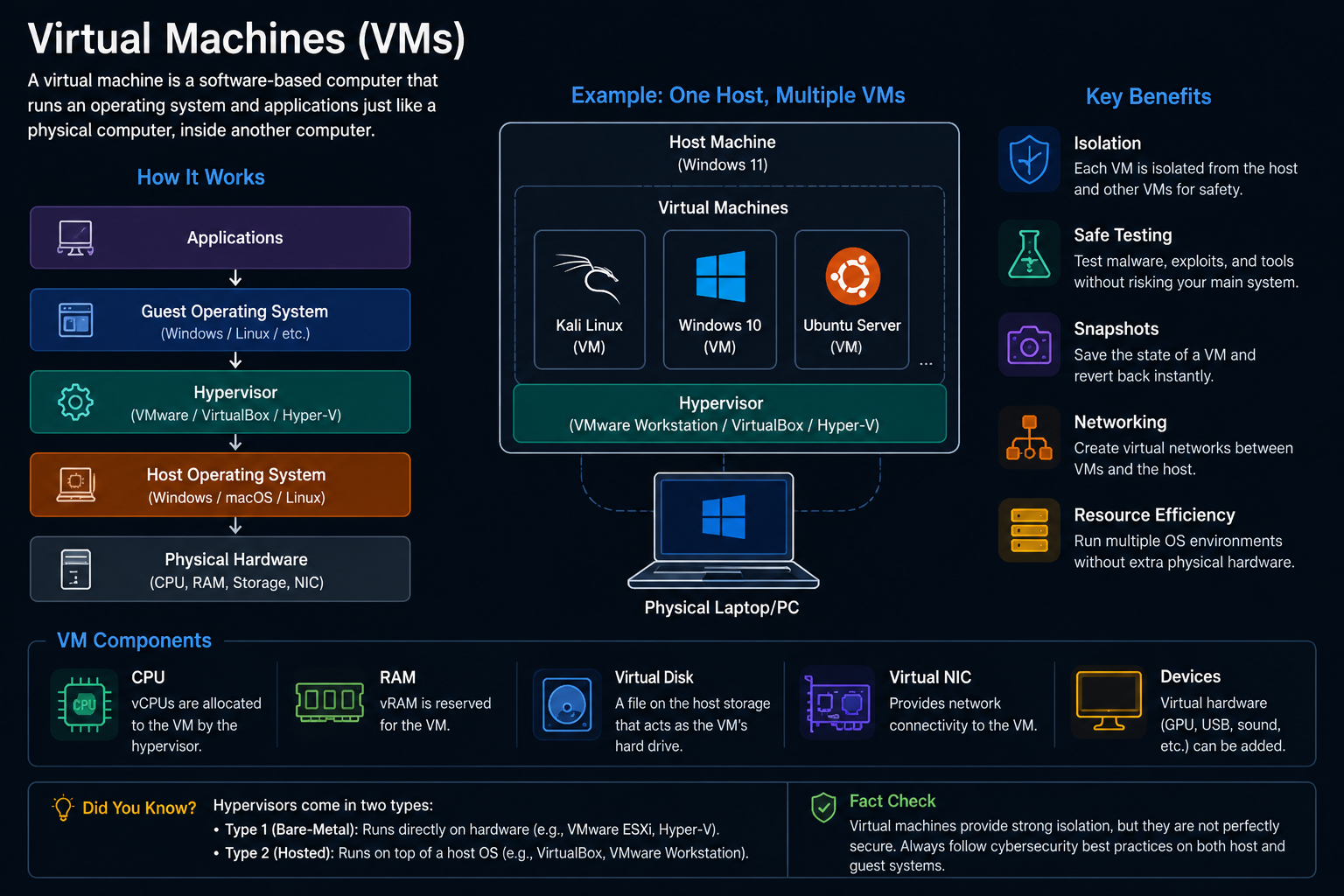
A Virtual Machine (VM) is a software-based computer that runs inside another computer.
Instead of installing an operating system directly onto physical hardware, a virtualization platform creates virtual hardware and allows an operating system to run on top of it.
Conceptually:
Physical Hardware
        ↓
Host Operating System
        ↓
Hypervisor
        ↓
Virtual Machine
        ↓
Guest Operating System
Example:
Physical Laptop
        ↓
Windows 11
        ↓
VMware / VirtualBox / Hyper-V
        ↓
Kali Linux
In this scenario:
- Windows is the host operating system.
- VMware, VirtualBox, or Hyper-V is the hypervisor.
- Kali Linux is the guest operating system.
Why Virtual Machines Matter
Virtual machines are one of the most important technologies in cybersecurity.
They allow operators to:
- Build isolated laboratories.
- Test malware safely.
- Practice attacks without affecting production systems.
- Create entire enterprise environments on a single computer.
- Take snapshots and revert mistakes instantly.
Without virtualization, building realistic cyber ranges would be expensive, slow, and risky.
Key Terminology
| Term | Meaning |
|---|---|
| Host | The physical machine running virtualization software |
| Guest | The operating system running inside the VM |
| Hypervisor | Software that manages virtual machines |
| Snapshot | A saved state of a virtual machine |
| Virtual Disk | A file that acts as a hard drive |
| Virtual Network | Software-defined networking between VMs |
Snapshots
One of the most powerful VM features is the snapshot.
A snapshot captures the current state of a machine.
Clean Kali Install
        ↓
Create Snapshot
        ↓
Experiment
        ↓
Break Everything
        ↓
Restore Snapshot